Persistence, Practice, and Power: Mildred Howard’s Life in Art
By Shaquille Heath
Left: Portrait of Mildred Howard in her Oakland studio, 2025. Photo by Christine Cueto. Image courtesy of the Oakland Museum of California.
Mildred Howard was born in San Francisco in 1945, and as you can imagine, a great deal has changed since that time. In 1945 the Second World War was finally coming to an end. Jim Crow laws were pervasively enforced to maintain segregation. The Civil Rights Movement was still two decades away. And James Baldwin, whose writings would influence some of the very artwork that made Howard renowned, hadn’t even published his first book yet.
Since 1945, and across five decades of her practice, Howard has created hundreds of artworks, managing to find the time to become a prolific artist — an artist throughout graduate school, an artist while raising and rearing children, an artist within the everyday hustle and bustle of life. She’s seen trends come and go, and remained steadfast to her craft. She’s faced rejection like a mirror, encountering it more times than most people can count. The sheer breadth of her work stands as a testament to her tenacity, among the strongest out there. And this will soon be on view in "Mildred Howard: Poetics of Memory," opening on June 12 at the Oakland Museum of California (OMCA).
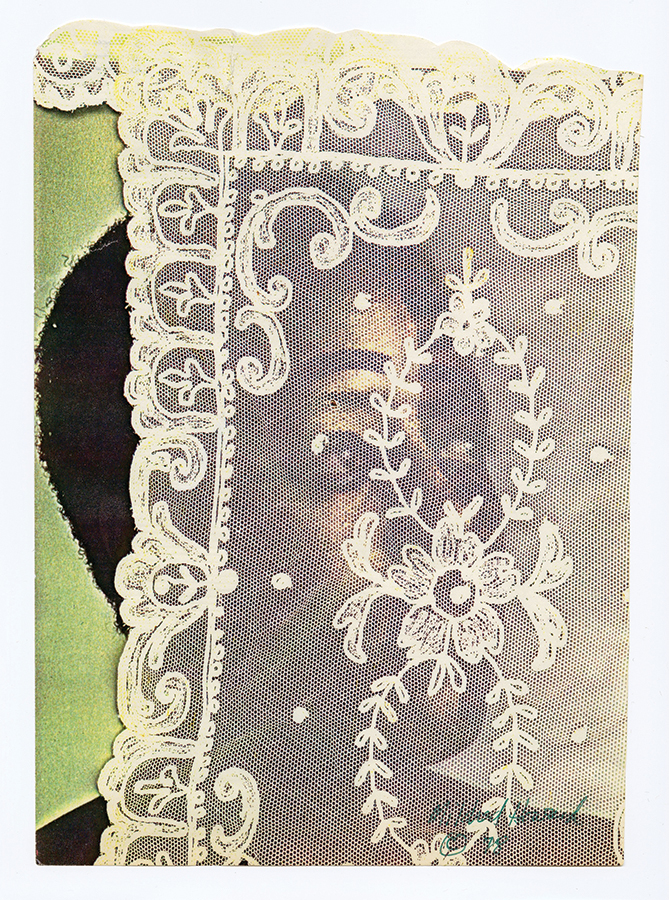
Mildred Howard. "Untitled," 1979. Xerox collage. Image courtesy Oakland Museum of California
As it has been noted, "Poetics of Memory" will offer visitors the opportunity to reflect on how personal memory and collective history become one of the same — how our individual experiences, though lonesome and isolating as they often feel, find company once we are brave enough to share them; how mass cultural moments are remembered not just by news archives, but by the journals and stories passed down from generation to generation from the ones who lived through it.
“Of course, I see the world from my perspective,” Mildred shared with me on a recent afternoon. “But the more you work, the more you begin to understand that your story is also someone else's story. That so many lives sort of cross one another.”
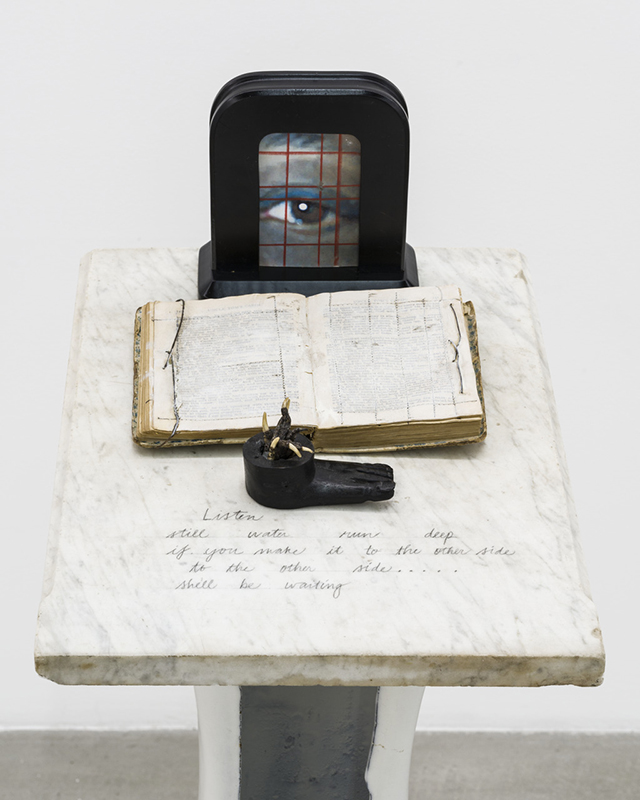
Mildred Howard. "A Salute to Sojourner, Still Water Run Deep," 2001 (detail); mixed media sculpture. Courtesy of parrasch heijnen, Los Angeles,
"Poetics of Memory" feels to be a fitting title for an exhibition comprised of artwork literally made from the remnants of moments fighting not to be forgotten. Family photographs, postcards, and glass houses serve as witnesses, as testimonies to moments both large and small, all worthy of sight and recognition. They often tell the stories of Blackness and identity, particularly from Mildred’s point of view, influenced by the world that has surrounded her — other artists, makers, and creatives. Or just folks clawing through the divine grind that is life.
And this was central to shaping how Mildred saw the world, as a faithful consumer of mediums outside of her own, she found fresh vantage points. “Writers and musicians are important because they provide a different avenue for understanding the world… Much of my work is inspired by what I read and by poetry, because you can see it. You can visualize it.” Mildred shares adoration for poets like Pablo Neruda and playwrights like Ishmael Reed. Her warm, tremulous voice turns to laughter as she tells a story about partying with James Baldwin at a party thrown by the first African-American tenured professor at UC Berkeley, Barbara Christian. With each inspired moment, her understanding of her place in the canon grows. “Where some people are great writers and musicians. I just see things visually.”
In many ways, this will become a sort of reunion for Howard, who told me that she hasn’t seen many of the pieces in decades. One such work is among Mildred’s most significant installations, a piece entitled "Crossings," which debuted at the Berkeley Art Center in 1997, one of her first solo exhibitions. It features ceramic eggs, delicately placed in front of a gilded mirror. Eggs, fragile in nature; eggs representing the moment before life; eggs symbolic of cycles, of repetition, of vulnerability. “The last time it was shown was in Cairo. The curator and historian Eddie Chambers, who is a British art history scholar. He brought it to the UK, and it traveled around. From there, I was invited to Cairo, Egypt as a cultural ambassador. That was in — maybe it was 2007… I have to look at my resume.”
If you had a resume like Mildred , you might also need to take a peek every now and then, to remember. In doing so, she traces the moments where doing was more important than being seen. While the exhibition at OMCA is a delight, Howard notes that rejection and triumph are a deep part of her story. “I have to tell you something. I applied to the Rockefeller Foundation. And then, I forgot about it, because you get a lot of no's when you're applying for things. Well, I got a phone call, and it was from one of the directors at the program, who said, 'We haven't heard from you. We sent you a letter.' So I went down to the bottom of my stairs, and I brought the envelope back up and opened it, and it said, 'Congratulations, you have been selected as the artist to go to Bellagio, Italy. I had no idea, no idea. I said, Can I hang up and call you back? I can't believe it.”
Mildred shares stories from her life as if each moment, she’s rediscovering them — a treasure trove of U-turns, redirects, happenstance, luck, perseverance, and ultimately passion. “Did you know I applied for the Guggenheim 16 times? [When I received the notice] I called them, because I kept reading the letter over and over again and was thinking, 'I don’t know if this is really true.' When I called, the head of that program was the one who told me. She said, 'You’ve tried 16 times. And I almost didn’t the last time - but I did. And I got it.” In the end, it is this insistence on doing that defines her story. And when recognition follows, all the better.
→ "Mildred Howard: Poetics of Memory," June 12 - October 18
Oakland Museum of California - museumca.org
Main image: Mildred Howard, Crossings, 1997. Antique gilded frame, ceramic eggs, filtered ambient light. Installation view, Berkeley Art Center, Berkeley, CA. Photo by Lewis Watts. Courtesy of The Mildred Howard Archive, The Bancroft Library, University of California, Berkeley.